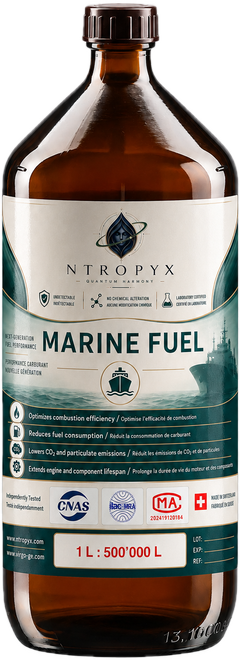
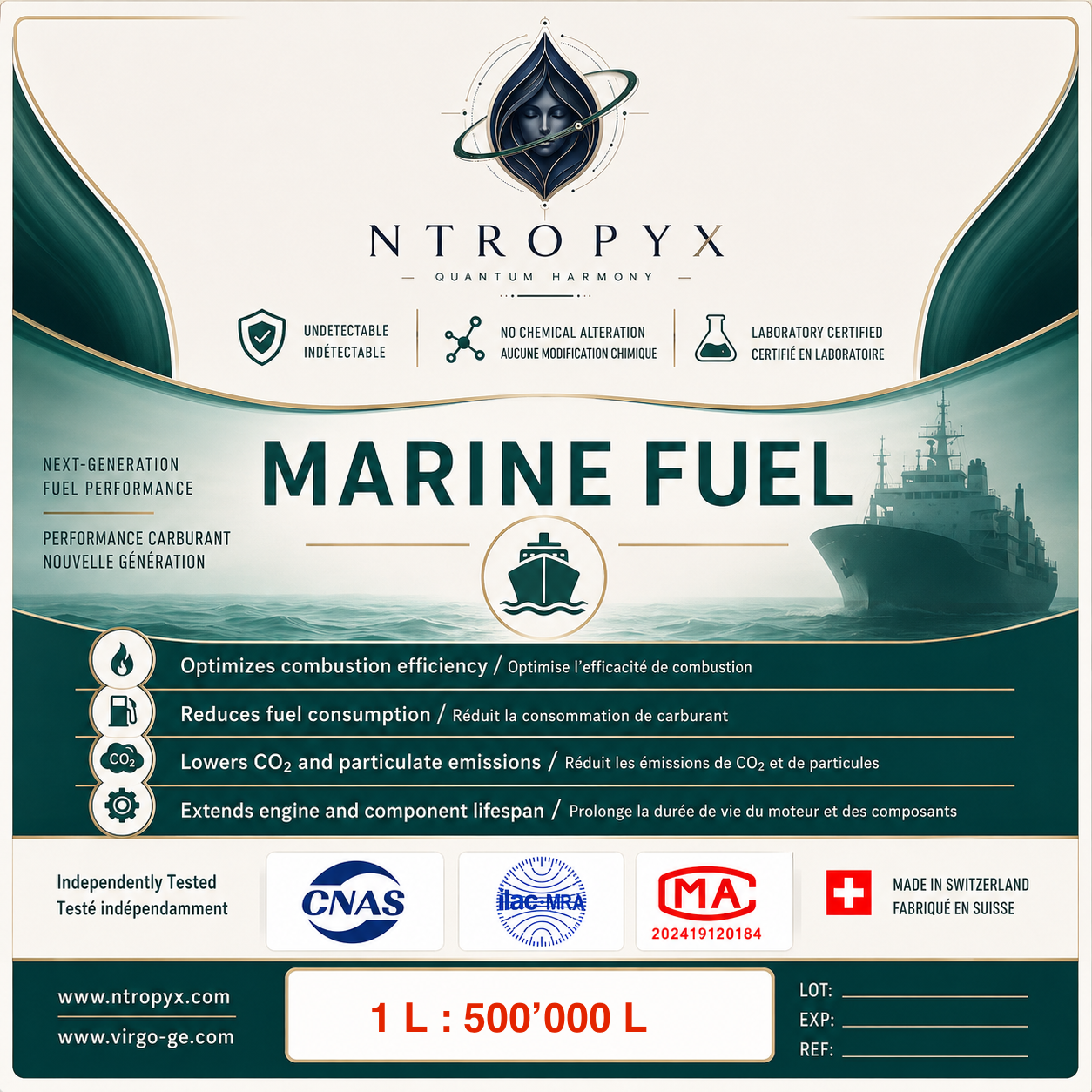
NTROPYX Marine
- 1 L glass bottle
- Marine diesel
- Treats 500 000 L
Make marine fuel work harder.
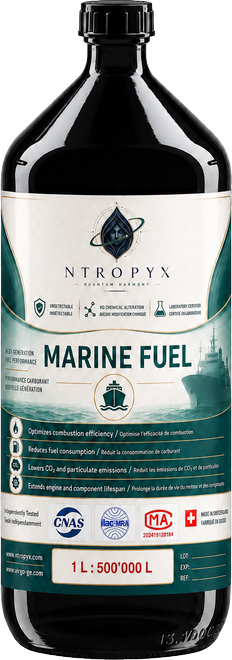
Built for real marine fuel families.
Brown and black marine NTROPYX address HSFO, VLSFO, MGO, MDO and IFO380 without hiding the engine context.
Two glass bottles for two grades of marine fuel. Brown is calibrated for the lighter marine diesel, black for heavy marine fuel.
Less fuel per kilowatt-hour on a Caterpillar C32 ACERT marine engine. Fuel weighed, not metered, by a CNAS L23122 accredited laboratory.1
Specific fuel consumption, mean of two campaigns. Expanded uncertainty ± 2.0% per reading.
Sulphur oxides by UV fluorescence. The laboratory describes the fall as in proportion to the fuel consumption decrease.
Residual oxygen in the exhaust, weighted over the E3 cycle. Uncertainty ± 1.0% per reading.
More power at every load point of the E3 cycle. Same engine, same fuel batch, same conditions: by the laboratory’s design, the catalyst is the only change.
Power at 100% load, 1,800 min⁻¹. Weight in the E3 cycle: 20%.
Power at 75% load, 1,638 min⁻¹. Weight in the E3 cycle: 50%.
Power at 50% load, 1,440 min⁻¹. Weight in the E3 cycle: 15%.
Power at 25% load, 1,134 min⁻¹. Weight in the E3 cycle: 15%.
Lower emissions of every species measured.
The products of incomplete combustion fall the furthest. Weighted over the E3 cycle, three samplings per condition.
Nitrogen oxides, Caterpillar C32, E3 cycle
Nitrogen oxides fall by 20.0%, against an uncertainty of ± 3.0% per reading.
Carbon monoxide
Unburnt hydrocarbons
Carbon monoxide and unburnt hydrocarbons, Caterpillar C32, E3 cycle
Carbon monoxide falls by 44.9% and unburnt hydrocarbons by 64.9%.
Particulates
Smoke number
Particulates and smoke number, Caterpillar C32, E3 cycle
Particulates fall by 68.6%, against ± 8.0% per reading; the smoke number by 81.0%, for which no uncertainty is stated.
NTROPYX is a molecular combustion catalyst. It is not consumed during combustion: it enables a more complete oxidation of the existing hydrocarbon fuel.
Read the procurement FAQBelow 20 ppm. Active concentration in treated fuel.
< 20 ppm
Engine makers’ specifications. Formulated to meet the fuel specifications recognised by major engine manufacturers.
No warranty issues. Operators using NTROPYX supply have not experienced warranty issues; we cooperate directly with OEM technical departments where relevant.
Eleven comparative analyses before and after treatment, from density to infrared spectrum. The laboratory’s conclusion: no measurable change in standard physicochemical parameters, within the detection limits of the methods.
One litre treats 500 000 litres of marine diesel.
No hardware.
No re-mapping.
Dosed at point-of-fill, into the bunker barge, the road tanker or the on-site storage tank.
Cooler under load.
Exhaust 20 to 32 °C cooler across the four E3 modes, from 490 to 458 °C at full power. In the laboratory’s reading, more of the fuel becomes work.
Keep NTROPYX away from electromagnetic fields. The product emits no field of its own, but exposure to one can neutralise it.
Marine bunkers — port state by port state.
European international maritime bunkers consumed 1 597 296 TJ of liquid fossil fuel in 2023 (Eurostat): about 44.4 billion litres, diesel-equivalent.3
74.3%
Fuel oil. Heavy fuel oil dominates ocean-going engines.
22.8%
Gas oil. Gas oil powers cleaner SECA-zone operations.
Million litres a year, fuel oil and gas oil
M/V KAYRA.

On board M/V KAYRA, a Phinisi moored at Serangan, Bali, two 42 kVA gensets used 18.3% less fuel over 12-hour runs at constant load, 15 to 18 March 2026. A comparative reading, not a laboratory one.2
Read the on-board reportFaster at sea.
On 23 March 2026, the GPS read a peak of 8.23 knots over ground during the turn, against a 7.00-knot baseline: 17.6% more.
+1.28 kt
Estimated speed through water, from 7.00 to 8.28 knots.
Supervised from the first dose.
Deployment dosing is supervised by our technical team; operational dosing is automated or manual, depending on the site.
An SDS, a technical datasheet and the dosing documentation, so your OEM and insurance teams can review.
We reply within one business day with a 30-minute technical call.

Every quarter, on record.
Each operational supply contract includes a quarterly report with litres saved, CO₂ avoided and the emissions delta (NOx, CO, HC, PM), formatted for direct integration into your ESG / CSRD reporting.
Contact the technical teamNitrogen oxides, Caterpillar C32 at 1,800 min⁻¹, against the IMO Tier II ceiling (MEPC.177(58)).
Nitrogen oxides with NTROPYX, from 7.40 g/kWh at baseline.
5.92 g/kWh
18.9 points of the ceiling freed.
Tier II ceiling at this speed: 7.8 g/kWh.
Below the ceiling, with no added after-treatment.
25% below
A typical fleet recovers the annual catalyst cost in the first two to three weeks of the contract.
Model ROI |
|
|
| NTROPYX Marine | NTROPYX Marine concentré | |
|---|---|---|
| Marine diesel. | Heavy marine fuel. | |
| On request | On request | |
| Buy | Buy | |
| Fuel treated | 500,000 L of fuel treated | 500,000 L of fuel treated |
| Packaging | 1 L glass bottle | 1 L glass bottle |
| Dosing | Dosed at point-of-fill | Dosed at point-of-fill |
| Use | Marine & heavy fuel | Marine & heavy fuel |
| Made in | Made in Switzerland | Made in Switzerland |
| Laboratory marks | CNAS, ilac‑MRA, CMA marks | CNAS, ilac‑MRA, CMA marks |
| Supply | Supplied from Lausanne | Supplied from Lausanne |
| Quotes | Quotes in CHF, EUR or USD | Quotes in CHF, EUR or USD |
Carbon dioxide down 15.0% per kilowatt-hour on the C32 bench.
6.21 billion litres of EU27 bunker fuel recoverable at a 14% catalyst factor.
Worth about €9.32 billion at an EU average bunker price of ≈ 1.50 €/L.
Derivation: Eurostat [nrg_bal_c] series INTMARB / siec O4680 (fuel oil 1 221 699 TJ) + O4671XR5220B (gas oil 375 597 TJ) = 1 597 296 TJ. Converted at diesel LHV 36 MJ/L → 44.37 Bn L diesel-equivalent. Sources · Eurostat Complete Energy Balances [nrg_bal_c], 2023. Switzerland excluded (landlocked). 2024 & 2025 not yet published in harmonised form by Eurostat; latest complete sectoral breakdown is 2023.


CNAS L23122, ILAC-MRA and CMA 202419120184 are accreditations of the issuing laboratory, not of NTROPYX or Virgo Global Energy.
Test reportsEngineered and produced in Switzerland since 2014 by Virgo Global Energy SA. Swiss Made on the product label.
ContactPricing scales with the annual fuel volume the catalyst is designed to treat. Quotes in CHF, EUR or USD, ex-works Lausanne.
Request commercial proposal